



play_arrow

keyboard_arrow_right

skip_previous play_arrow skip_next
00:00 00:00
playlist_play chevron_left
volume_up
play_arrow

Pharmaceutical Packaging

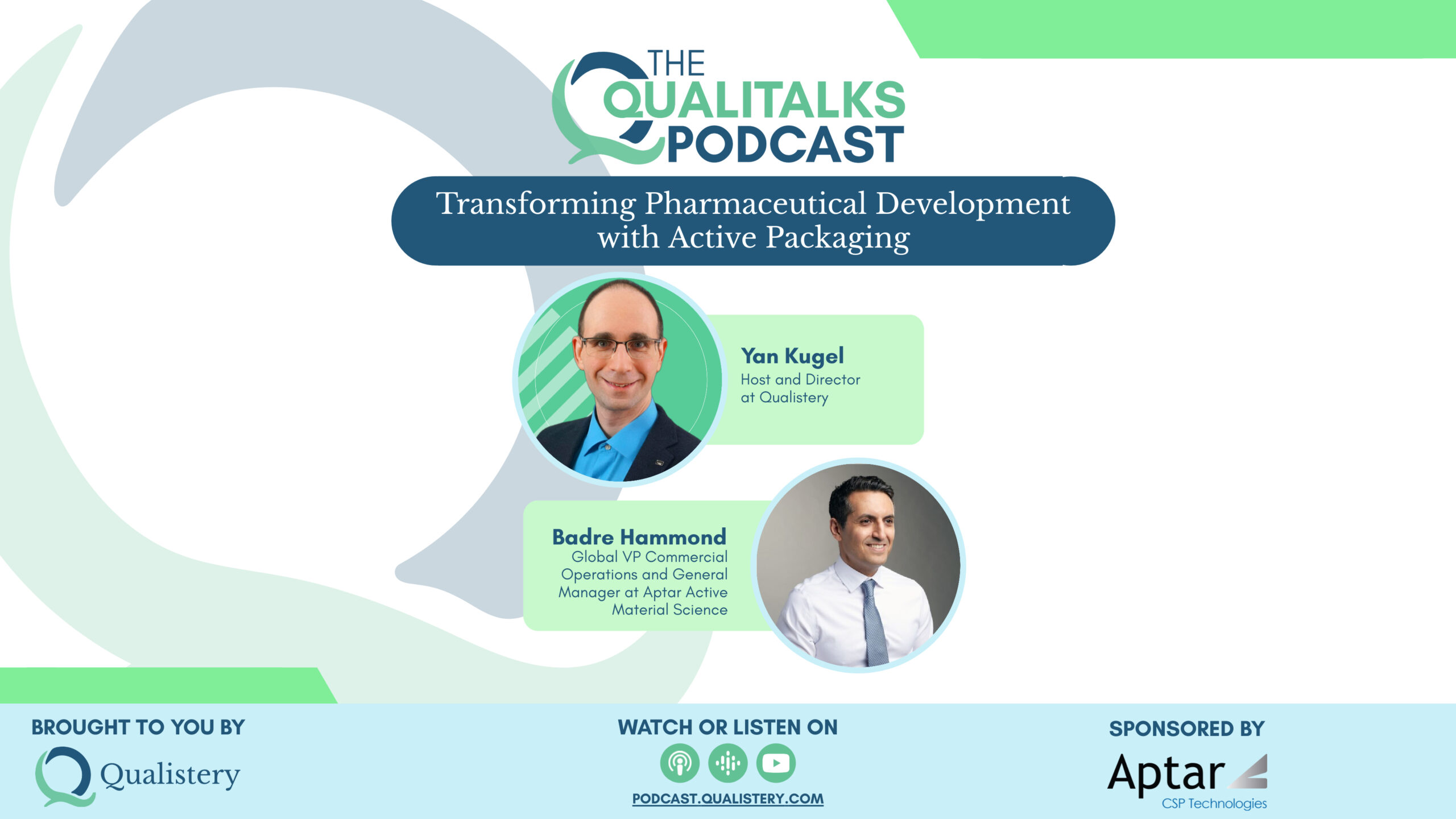
Transforming Pharmaceutical Development with Active Packaging [Badre Hammond]

Badre Hammond June 4, 2026 1


Background
share close

Introduction

Packaging is often treated like the last step in drug development. Pick a container, seal the product, ship it out. However, the concept of active packaging points out why it should be part of product design from the start, not an afterthought.  Active packaging is not just about holding a drug in place. It can help create a better environment inside the package. That can support stability, control impurities, and help the product keep its performance over time.

This article summarizes key insights from the discussion between Yan Kugel and Badre Hammond (Global VP Commercial Operations and General Manager at Aptar Active Material Science).  It reveals how active packaging can transform drug development

This episode is supported by Aptar. They are the premier active material science solutions expert that accelerates and de-risks the product development process, and provides complete solutions that improve consumers’ and patients’ lives. Whether you need a solution to ensure product stability and extend shelf life or are seeking a customized, end-to-end solution for your drug delivery system that improves consumers’ experiences, AptarActive Material Science delivers on its promises to our partners, consumers, and patients.

Learn More About Aptar


What Active Packaging Really Does

Normal packaging primarily serves as a container-closure system. It keeps the product inside and helps protect it from the outside environment.

Active packaging does more than that. It can create a microclimate inside the package. That means it helps manage what is happening inside the headspace around the drug product. In other words, it can protect the product from both outside factors and internal issues.

This becomes important when a drug is sensitive to moisture, oxygen, or other sources of degradation. The speaker explained that active packaging can play a dual role. It helps protect the product from the outside and also helps control what happens inside the package.

Why Timing Matters So Much

Many drug developers think about packaging too late. A formulation team may work hard to create a recipe that meets the target dose and performance needs. Then the packaging team enters the picture near the end. 

Instead, packaging and material science should be part of formulation thinking from day one. If a team knows there may be an oxidation issue, for example, it should think about how packaging might help solve that issue early. That way, the formulation does not need to carry the full burden alone. Rather than fixing problems after the formulation is finished, teams should bring packaging into the design work from the start. That can reduce back-and-forth between teams and save time. 


Customization Is the Key

Active packaging is not a one-size-fits-all solution.

Different drugs have different needs. Some need protection from moisture. Some need protection from oxygen. Some need both. Some products need a certain amount of moisture to stay stable, while too much protection can dry the product out and make it brittle.

That means the packaging must be tailored to the product. Companies need to know the product goal first. What stability target does the drug need? What kind of environment does it require? How much oxygen transmission can it tolerate? Only then can the material science team design the right solution. 

This work is not about shipping the same material to every customer. It involves creating chemistry for a specific need. In some cases, companies may need different solutions for different regions because climate zones and regulatory needs vary. 

Global Markets Bring More Complexity

A product may need to work in North America, Latin America, Southeast Asia, and other regions with different humidity and temperature levels. That creates real pressure on packaging design.

Regulations also differ across markets. For instance, the FDA and EMEA may look at certain issues in different ways. Some impurity levels that may be acceptable in one region may not be acceptable in another.

That means companies may need packaging solutions that work globally, or they may need different materials for different markets. Packaging choices affect not just the product itself, but also where and how it can be approved and sold.

Regulatory Support Is Part of the Job

Companies should not expect drug developers to handle all of the regulatory burden alone when it comes to active packaging. In his view, packaging partners should help provide the regulatory package as part of the solution.

That includes support for guidance, extractables, testing, robustness, and submission needs tied to the material itself.

Attention all pharma professionals!

Stay ahead of the game and be fully compliant with regulations.

Join Qualistery’s expert-led educational webinars and stay up-to-date with the latest trends and regulations.

With top industry providers as our partners, we bring you the best speakers and informative sessions.

Visit our website to browse our upcoming webinars and take the first step toward furthering your knowledge and success in the industry.

Don’t miss out on this opportunity to invest in your professional growth.

Visit Qualistery now!

Browse GMP Webinars


Why Earlier Thinking Can Save Time

Does active packaging add time to development, or does it help speed things up? 

In reality, it can save time when it is used early. It becomes critical for products that have a limited shelf life.  Some material formulations, implemented early, can enhance the shelf life of a life-saving drug by three times. 

This kind of result matters in many ways. It can reduce pressure on the supply chain. It can make planning easier. It can also help a product reach more patients in a usable form. If packaging is considered late, teams may spend years going back and forth between formulation, packaging, and CMC work. Early thinking can reduce those loops. 

Preventing Problems Like Nitrosamines

Some APIs can form nitrosamines when exposed to certain precursors, such as nitrite. If those levels get too high, a product can be pulled from the market. That makes prevention very important. 

Active packaging can help reduce this risk by managing the environment inside the package before the impurity forms. Some companies have had to reformulate after impurity levels increased. That is another reason why prevention matters more than reaction. 

Quality and GMP Cannot Be an Afterthought

Active packaging materials must be made under strong quality systems and GMP conditions. The goal is not to solve one problem while creating another.

Some teams work hard in early development to make sure the materials are clean and that they do not introduce new impurities. They buy raw starting material and engineer it in-house. That includes particle sizing and morphology work.

Patient use is the final test. These materials may support oral solid doses, implants, pacemakers, and other products used by real people. So the quality bar is very high.

Sustainability Through Longer Shelf Life and Less Waste

Sustainability can be viewed in more than one way. One way is through a longer shelf life and less product waste. If a product stays stable longer, fewer products are thrown away early.

Let’s take the example of probiotics. Since probiotics contain live microorganisms, they can lose viability because of temperature, humidity, and VOC exposure. Some companies add more microorganisms to make up for that loss. Active packaging can reduce that need by helping protect what is already there.

Final Thoughts

Active packaging is not just a support tool at the end of development. It can shape product performance, stability, regulatory planning, shelf life, and patient access from the beginning. 

For pharma teams working on formulations, drug delivery, or device products, the message is worth serious attention. Packaging deserves a place in early design discussions. 

Download now: Transforming Pharmaceutical Development with Active Packaging [Badre Hammond]

file_download Download

Rate it
Avatar
Author

Badre Hammond

Badre E. Hammond is a senior pharmaceutical business leader with more than 20 years of experience in CDMO services, drug delivery, medical devices, and active material science packaging. At Aptar CSP Technologies, he leads global commercial operations and APAC growth, helping pharma and life science partners protect product stability, support quality, and bring complex therapies to market. His work includes active packaging solutions for probiotics, nasal drug delivery, and nitrosamine risk reduction. Badre is known for building strong teams, shaping growth plans, and connecting science with practical business needs. He regularly shares industry insights on pharma packaging, product protection, and patient-focused solutions.

list Archive

Previous episode

Post comments

This post currently has no comments.

Leave a reply

Your email address will not be published. Required fields are marked *