


play_arrow

Featured

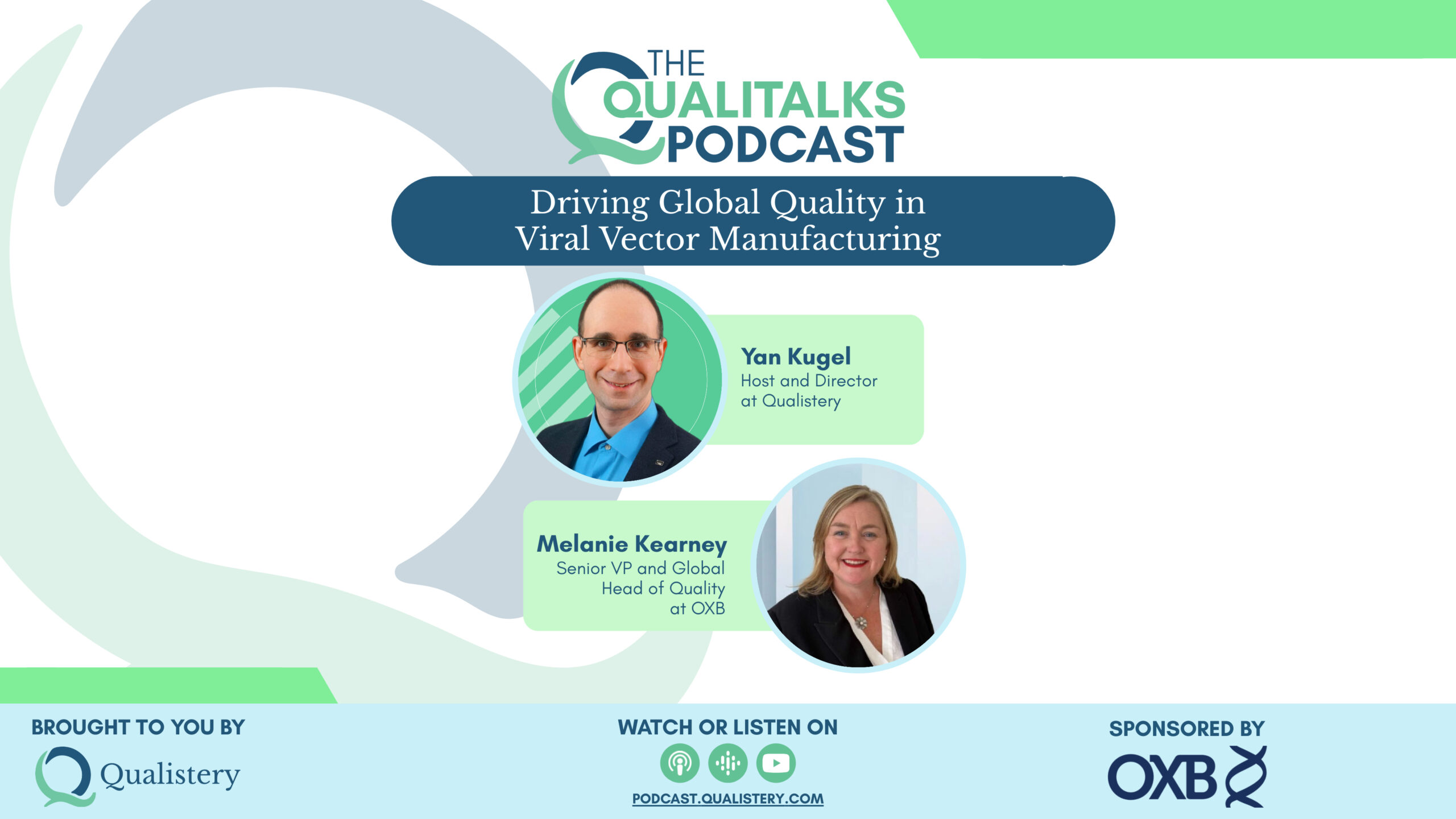
Driving Global Quality in Viral Vector Manufacturing [Melanie Kearney]

Melanie Kearney April 29, 2026


Background
share close

This episode is supported by OXB. OXB stands at the forefront of cell and gene therapy innovation, supporting its clients deliver life-changing therapies to patients around the world. With 30 years of experience, OXB is a recognised global leader in the development and manufacture of viral vectors – a key component in cell and gene therapies that target a wide range of diseases, from rare genetic disorders to cancer.

Learn More About OXB


Why does cross-functional experience make better quality leaders?

Interestingly, Melanie didn’t start in quality. She began in R&D and later worked in analytical development, QC, technical services and plant operations. That breadth lets her see where problems originate and design QMS elements that actually work in practice. Encourage rotations or cross-functional projects (R&D ↔ QC ↔ manufacturing). When quality people understand upstream and downstream work, they create more practical controls and smoother technology transfers.

How do you keep development and commercial tightly connected?

Methods that are hard to scale create avoidable manufacturing problems. Final development stages must be designed for transfer to commercial scale. Build mandatory handoffs and joint acceptance criteria between development and commercial teams, and use the same core electronic QMS across sites so development doesn’t become an island.

Can lessons from one sector help another?

Yes. Regulatory detail and manufacturing style vary, but core quality principles like patient safety, root cause analysis, and inspection readiness remain constant across sectors. Melanie borrows rapid deviation management from radiopharma and applies it in viral vectors. Capture lessons across product areas (for example, radiopharma’s need for fast root-cause resolution) and pilot their impact elsewhere.

How do you build a quality culture that actually sticks?

Be visible and culturally fluent. Melanie visits sites regularly, speaks local languages where possible, and prioritizes face-to-face engagement because trust grows from presence, not emails. Senior quality leaders should budget travel and time for site visits, town halls, and operator-level conversations. To summarise, small investments in the local context speed up adoption.

How do you make change without alienating people?

Make change with people, not to people. Expect resistance and plan for it. Use clear communication, Kaizen events, and inclusive continuous-improvement methods. For every process change, run a cross-functional Kaizen with representation from operator to manager and explain the reason “why” in practical terms.  Elaborate on how it entails things like fewer steps, less rework, and safer outcomes.

What’s the right approach for CDMOs?

Standardize where it matters; be client-centric where it counts. A CDMO serves clients at different stages and with different expectations. Use one robust, inspectable QMS plus flexible, transparent client communication. Operate in a single internal quality system, give clients tailored visibility, avoid multiple internal systems, and keep strict separation of client data — discretion is non-negotiable.

Is audit readiness a project or a habit?

Audit readiness must be a constant state. Unannounced inspections happen, so pre-identify subject-matter experts and maintain electronic backrooms for rapid evidence sharing. Move to electronic document and evidence management, keep an up-to-date SME roster with backups, and treat every audit as an opportunity to improve.


Attention all pharma professionals!

Stay ahead of the game and be fully compliant with regulations.

Join Qualistery’s expert-led educational webinars and stay up-to-date with the latest trends and regulations.

With top industry providers as our partners, we bring you the best speakers and informative sessions.

Visit our website to browse our upcoming webinars and take the first step toward furthering your knowledge and success in the industry.

Don’t miss out on this opportunity to invest in your professional growth.

Visit Qualistery now!

Browse GMP Webinars


When should you push back on regulators and how?

Pushback is possible, but it must be respectful, targeted and evidence-based. Quote the precise regulation or guideline and present supporting data. However, if the authority is immovable, one should look for systemic risk across sites and fix it globally rather than arguing in isolation.


How should escalation work in a quality organisation?

Prioritize escalation by impact and stay accessible. Melanie expects rapid escalation for issues with patient impact and keeps an open door for her teams. It is pivotal to define clear escalation timelines and criteria (patient impact, supply interruption, regulatory exposure), train teams to escalate appropriately, and ensure leaders are reachable for quick decisions.

How do you get budget and influence from the board?

To do that, one must speak the board’s language and show quality as strategic value, not just cost. Tying quality metrics to business outcomes often can prove effective. Parameters like cost avoidance, time-to-market, regulatory certainty and reputation protection become crucial points in such discussions.. Translate QA KPIs into business terms (for example: deviation closure time → fewer batch losses → revenue protection). Work with finance early to align metrics, demonstrate capacity and utilization, and build credibility for headcount and budget requests.

How do you get budget and influence from the board?

To do that, one must speak the board’s language and show quality as strategic value, not just cost. Tying quality metrics to business outcomes often can prove effective. Parameters like cost avoidance, time-to-market, regulatory certainty and reputation protection become crucial points in such discussions.. Translate QA KPIs into business terms (for example: deviation closure time → fewer batch losses → revenue protection). Work with finance early to align metrics, demonstrate capacity and utilization, and build credibility for headcount and budget requests.

What career moves accelerate your growth in quality?

In order to be a successful quality leader, one must be deliberate about career goals and say yes to stretch opportunities. Be willing to relocate and work across geographies to gain perspective and influence. Volunteer for high-visibility projects, speak up in meetings, and stay curious — continuous learning keeps the work rewarding.

Why do these lessons matter for viral vectors and advanced therapies?

These products are biologically complex and variable.  They require QMSs that are robust, agile, and human-centered. CDMOs must serve diverse clients, remain inspection-ready, and scale operations without risking supply. Leaders who combine technical credibility, cross-functional experience, cultural fluency, and the ability to speak to the C-suite enable safe, timely patient access to innovation.

Simple, practical next steps you can start this quarter:

  • Map a 6–12 month cross-functional rotation program covering R&D, QC and manufacturing for future quality leaders.
  • Standardize your core QMS across development and commercial sites using the same eQMS instance and SOP baseline.
  • Create a quarterly “inspection learnings” review: when one site gets an observation, review applicability across all sites and implement pre‑emptive fixes.
  • Run Kaizen workshops with operator representation for any change that touches production workflows.
  • Convert audit evidence and backroom capability to electronic format and maintain an SME roster with backups.


Conclusion

Melanie Kearney’s approach is practical, people-centered, and strategic. In high-stakes areas like viral vectors and cell & gene therapy, that combination lets companies innovate without compromising safety, compliance, or commercial outcomes. According to her Quality isn’t a cost center, but it’s a driver of sustainable delivery to patients.

Guest

  • Melanie C J Kearney is a highly experienced senior quality executive with extensive expertise across the biotechnology, pharmaceutical, radiopharmaceutical, and FMCG sectors. She currently serves as Senior Vice President Head of Global Quality at OXB. With over 20 years of leadership experience, Melanie has successfully driven compliance and quality initiatives, improving performance and fostering strong quality cultures in both start-ups and established organizations.

    Her technical background covers drug substance and drug product manufacturing, including aseptic processing, terminal sterilization, and lyophilization. Melanie has held senior roles at leading companies such as Sanofi and Curium Pharma, overseeing global quality and regulatory functions that support clinical, commercial, and pharmacovigilance activities.

    Melanie is known for her collaborative approach and integrity. Her skills include quality assurance (QA), quality control (QC), global communication, and audit leadership. Having served on corporate boards, she is adept at navigating complex regulatory environments while enhancing operational efficiency.

    Her dedication to advancing quality standards and enabling innovative therapies makes her a respected leader in regulated industries. Melanie combines compliance expertise with a focus on innovation, helping organizations accelerate development timelines without compromising quality.

    View all posts Senior Vice President & Global Head of Quality at OXB
Rate it
Avatar
Author

Melanie Kearney

Melanie C J Kearney is a highly experienced senior quality executive with extensive expertise across the biotechnology, pharmaceutical, radiopharmaceutical, and FMCG sectors. She currently serves as Senior Vice President Head of Global Quality at OXB. With over 20 years of leadership experience, Melanie has successfully driven compliance and quality initiatives, improving performance and fostering strong quality cultures in both start-ups and established organizations. Her technical background covers drug substance and drug product manufacturing, including aseptic processing, terminal sterilization, and lyophilization. Melanie has held senior roles at leading companies such as Sanofi and Curium Pharma, overseeing global quality and regulatory functions that support clinical, commercial, and pharmacovigilance activities. Melanie is known for her collaborative approach and integrity. Her skills include quality assurance (QA), quality control (QC), global communication, and audit leadership. Having served on corporate boards, she is adept at navigating complex regulatory environments while enhancing operational efficiency. Her dedication to advancing quality standards and enabling innovative therapies makes her a respected leader in regulated industries. Melanie combines compliance expertise with a focus on innovation, helping organizations accelerate development timelines without compromising quality.

list Archive

Previous episode

Post comments

This post currently has no comments.

Leave a reply

Your email address will not be published. Required fields are marked *