


• Home
  • keyboard_arrow_right Featured
  • keyboard_arrow_right Data Integrity
  • keyboard_arrow_rightPodcasts
  • keyboard_arrow_right
  • keyboard_arrow_right Overcoming Tech Transfer Bottlenecks: From Paper Trails to Standardized Digital Hubs [Nikki Bishop]
play_arrow

Featured

Overcoming Tech Transfer Bottlenecks: From Paper Trails to Standardized Digital Hubs [Nikki Bishop]

Nikki Bishop June 25, 2026 1


Background
share close

Introduction

Tech transfer is not just one problem. It is several problems stacked together. There is human communication. There is a technical transfer. There is a regulated setting that requires proof, traceability, and control. When those three things meet, delays grow fast.

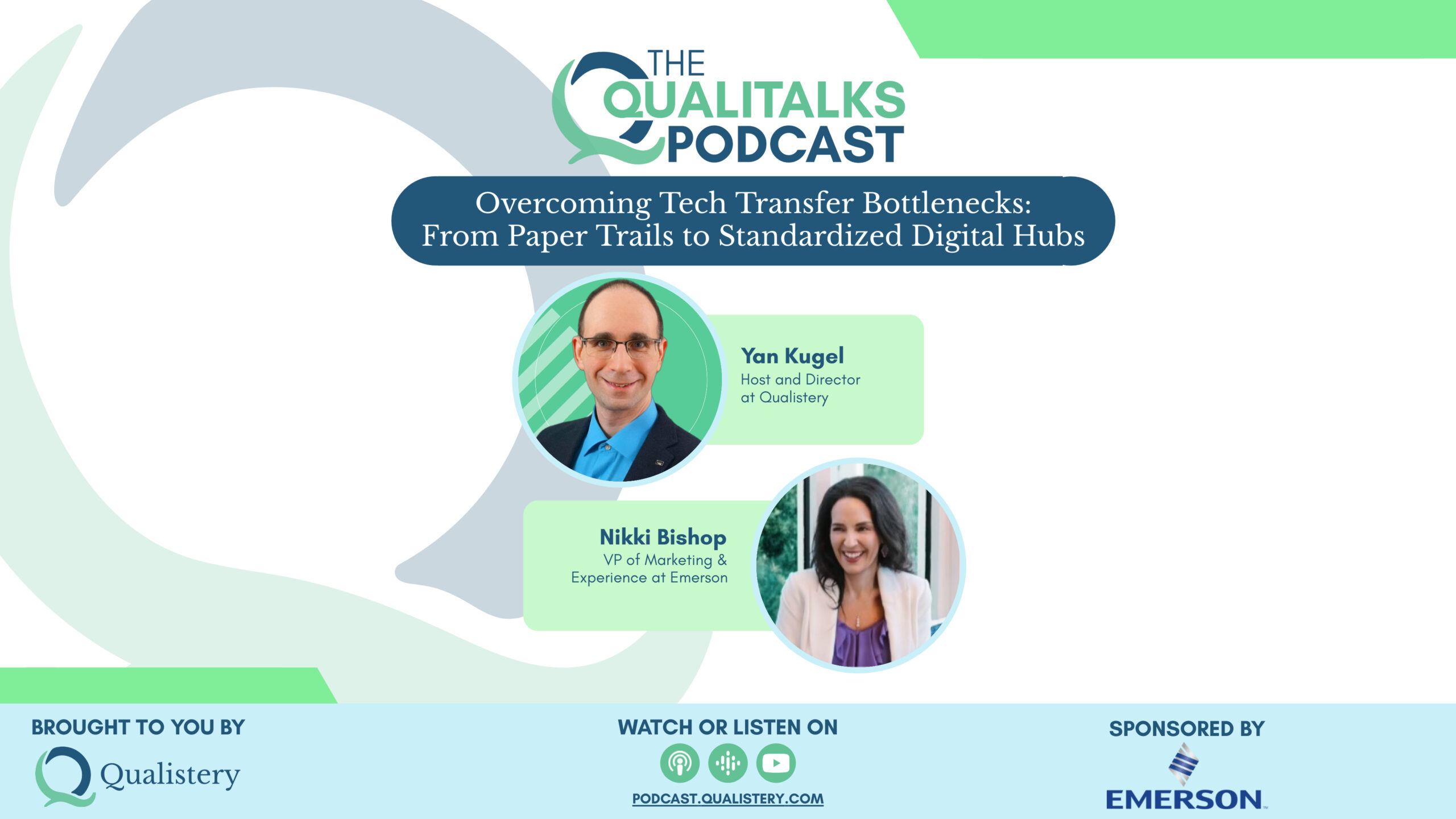
This article summarizes key insights from the discussion between Yan Kugel and Nikki Bishop, VP of Marketing & Experience at Emerson.  It explores why tech transfers in life‑science manufacturing drag on and how digital tools, including, AI can actually speed things up. 

This episode is supported by Emerson. They are a global leader in automation technology and industrial software, providing innovative solutions that help life sciences manufacturers optimize operations, enhance efficiency, and ensure regulatory compliance. With a focus on digital transformation, Emerson enables smarter, data-driven decision-making to drive productivity, quality, and sustainable growth in highly regulated industries.

Learn More About Emerson


Why does tech transfer keep getting stuck?

One of the biggest reasons is that the process is often not captured well enough from the start. A process may have worked beautifully at one site, but if the know-how was never recorded in a clear and standard way, the next site has to guess, translate, and fill in the blanks.

That is where trouble begins. A recipe may say what should happen, but not always how it happened in practice. A batch step may be described, but the small details that made it work can be lost. Was the equipment behaving a certain way? Was there a tiny adjustment made by an experienced operator? Was a step done slightly differently because of local conditions? If that knowledge was never captured, it becomes hard to reproduce.

This is why the issue is bigger than documentation alone. It is really about knowledge capture. The knowledge may sit in paper records, digital files, databases, or even in someone’s head. The problem is whether that knowledge is clear, standard, and easy for the next team to understand.

Without that, every transfer becomes a bit like the childhood telephone game. Each time the message moves, a little meaning gets lost.

Why does the facility matter so much?

Another point that came through strongly is that a transfer does not happen in a vacuum. The receiving site matters a lot.

Before a process moves, teams need to know what the new facility can actually handle. Can it run the process as designed? Does it have the right equipment? Is that equipment free when needed? Does the site have the right layout, utilities, and support systems? If not, changes will be needed.

That sounds simple, but it often gets missed too late. Then teams are forced to catch up. They discover that a machine must be added or replaced. Or they learn that the needed equipment is already tied up with another process. Every one of those surprises adds time.

This is one reason tech transfer can stretch on for years. It is not just about moving a process. It is about matching a process to a real site with real limits.

Why is context so important across each step?

A process in pharma is not one flat thing. It changes as it moves from development to manufacturing to distribution. Each stage has different needs.

Early on, the work may be about process intent. What is the goal? What is the science behind it? What is the molecule doing? Later, the focus shifts to exact settings, acceptance criteria, and equipment behavior. The people at each step need different kinds of information.

That is where many transfers fail. Teams often hand off data without enough context. The next group receives the information, but they may not fully understand what it means in their part of the process. Then they have to stop, ask questions, and go back for clarification.

The key lesson here is that tech transfer is not just about passing data down the line. It is about passing meaning. If the meaning is weak or incomplete, delays follow.

Why do so many projects run out of time or value?

A major concern in the discussion was timing. In pharma, a product can take many years to develop. If tech transfer adds many more years, the market may change before the work is finished.

That is a real business risk. A project can look strong at the start and then lose its case by the end. A competitor may move faster. The market may shift. The value of the product may change. Even if the transfer eventually works, it may no longer make economic sense.

This is why speed matters so much. Tech transfer is not just a back-office task. It can shape whether a product reaches patients on time and whether the project still makes sense when it is done.

Attention all pharma professionals!

Stay ahead of the game and be fully compliant with regulations.

Join Qualistery’s expert-led educational webinars and stay up-to-date with the latest trends and regulations.

With top industry providers as our partners, we bring you the best speakers and informative sessions.

Visit our website to browse our upcoming webinars and take the first step toward furthering your knowledge and success in the industry.

Don’t miss out on this opportunity to invest in your professional growth.

Visit Qualistery now!

Browse GMP Webinars


Is paper still slowing the industry down?

Yes. And in a surprising number of places, it still is.

The discussion made a strong case for moving away from paper. Large paper packages, manual reviews, physical signatures, and archiving all slow things down. They also create more room for missing details, signature problems, and audit issues.

Paper is not just slow. It is hard to search, hard to share, and hard to standardize. If a folder is missing a page or a note is hard to read, the team loses time. If records sit in boxes or off-site storage, even simple checks become a project.

Digital records change that. They make it easier to search, share, review, and track. They also create a better path for audit readiness. That does not mean paper disappears overnight. But it does mean companies can start reducing the load right away.

The advice was simple. Start somewhere. Do not wait for the perfect moment. Even one step toward digital records can save time later.

Can AI really help here?

AI came up often in the conversation, but with a very practical tone. The point was not that AI should replace people. The point was that it can help people work faster and with better information.

For example, AI can help scan, sort, and summarize records. It can help search large sets of documents faster than a person can. It can also help bring structure to records that were never standardized well in the first place.

That said, the human role is still central. The discussion kept coming back to this idea. AI can support the work, but people still need to ask the right questions, check the results, and make the final calls. In a regulated industry, that caution matters.

The best use of AI here seems to be support, not replacement. It can help reduce manual effort, but it should work within strong guardrails.

Why do standards matter so much?

One of the clearest ideas from the conversation was the need for shared standards. If every company, site, or team builds its own version of the process, then every transfer becomes a custom job.

That is slow, expensive, and hard to scale.

Shared standards would make it easier to build tools, templates, and digital systems that work across teams. They would also make it easier to translate process intent into manufacturing-ready information.

This is where industry-wide teamwork matters. No single company can solve the full problem alone. The progress will come faster if companies, vendors, and other groups agree on common ways to describe and move information.

What role does change management play?

A very big one.

Even if the technology is ready, people may not be. That may be the hardest part of all. Teams get used to working one way. They trust what they know. Changing that can feel risky, especially in a field where mistakes carry serious consequences.

That is why change management cannot be an afterthought. It has to be part of the plan from the start. People need to understand not just what is changing, but why it matters. They need support. They need time. They need a clear path forward.

The conversation suggested that the best person to guide this may not be defined by title alone. It may be someone who can see across the whole process, connect people, and keep the work moving. In other words, someone who can lead the handoffs, not just manage tasks.

Is one-click tech transfer really possible?

The phrase sounds bold, and it is. But the idea behind it is serious.

The vision is a future where much of the transfer work can happen digitally. Site specs, equipment profiles, translations, templates, and records could all move through a connected system. That would cut down on manual work and reduce delays.

Will every case be simple? No. There will always be exceptions. Equipment may be down. Sites may differ. Human judgment will still be needed.

But the idea is that much of the routine work could become faster and more reliable. The discussion suggested that this future may not be far away. Five years was mentioned as a real possibility.

That would be a major shift for the industry.

What should companies do now?

The strongest message from the discussion was also the simplest one. Start.

Do not wait for a perfect system. Do not wait until the whole process can be rebuilt from scratch. Pick one thing that can be improved today. Move one record from paper to digital. Fix one handoff. Standardize one template. Ask a better question before the next transfer step.

Small steps can matter more than people think. They build momentum. They reduce fear. They show teams that change is possible.

The lesson from this podcast is clear. Tech transfer does not have to stay slow forever. Better knowledge capture, more digital tools, stronger standards, and better teamwork can all move the process forward.

The challenge is big. But the path forward is already visible.


Download now: Overcoming Tech Transfer Bottlenecks: From Paper Trails to Standardized Digital Hubs [Nikki Bishop]

file_download Download

Rate it
Avatar
Author

Nikki Bishop

Nikki Bishop is the VP of Marketing & Experience at Emerson, where she leads end-to-end software portfolio strategy and marketing for Emerson’s life sciences software business. Her role spans product marketing, brand strategy, demand generation, go-to-market planning, commercialization, customer success, product engineering, and long-term portfolio direction. She focuses on helping life sciences manufacturers adopt digital tools and human-led AI in practical, trusted ways that fit the needs of regulated manufacturing. With a clear view of both technology and the people who use it, Nikki helps translate complex software capabilities into business value, stronger customer adoption, and better manufacturing outcomes.

list Archive

Previous episode

Post comments

This post currently has no comments.

Leave a reply

Your email address will not be published. Required fields are marked *