


• Home
  • keyboard_arrow_right Featured
  • keyboard_arrow_right Biomanufacturing
  • keyboard_arrow_rightPodcasts
  • keyboard_arrow_right
  • keyboard_arrow_right
  • keyboard_arrow_right Reducing Risk and Costs: Continuous Water Quality Monitoring in Pharmaceutical Production [Konrad Sägesser]
play_arrow

Featured

Reducing Risk and Costs: Continuous Water Quality Monitoring in Pharmaceutical Production [Konrad Sägesser]

Konrad Sägesser August 31, 2026 1


Background
share close

Introduction

Pharmaceutical water often works quietly in the background. It may not receive the same attention as drug discovery, filling, or packaging. Yet water can make up most of a medicine, serve as a process medium, or come into direct contact with products and equipment.

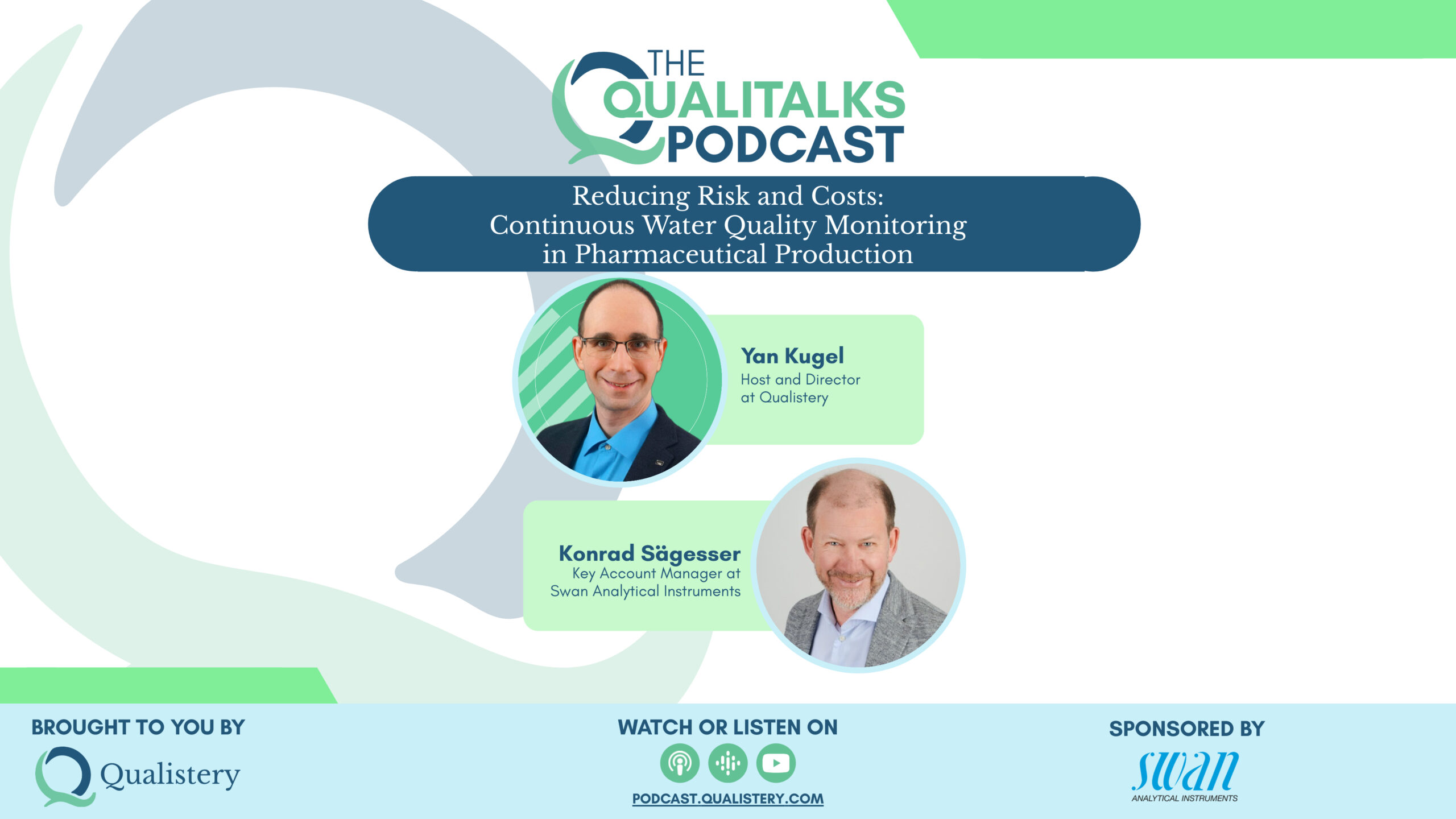
This article summarizes key insights from the discussion between Yan Kugel and Konrad Sägesser, the Key Account Manager at Swan Analytical Instruments, as they discuss how continuous analytics, compliance, sustainability, and AI are reshaping water management in pharma manufacturing. 

Konrad is a subject matter expert and co-author of the A3P Guidelines, alongside industry experts from Sanofi, BWT, and Veolia.

This episode is supported by Swan Analytical Instruments They offer a comprehensive range of measurement parameters designed for diverse applications across multiple industry sectors. Their solutions help customers achieve reliable, accurate, and efficient water quality control in industries including power generation, drinking water, pharmaceuticals, healthcare, wastewater treatment, and industrial process monitoring.

Learn More About Swan


Why Pharmaceutical Water Needs More Attention

Water is not just a utility in pharmaceutical manufacturing. It can be a raw material, a cleaning agent, or part of the manufacturing process.

For some medicines, water makes up nearly the entire product. Even when water is not part of the final product, it may come into contact with equipment, containers, or active ingredients. A small change in water quality can affect the process or create a risk to the product.

This is why pharmaceutical water systems require careful design, qualification, monitoring, and maintenance.

Water systems also face changing demands. Manufacturers want to reduce water and energy use. They want to use more membrane systems and less thermal distillation where suitable. They want better records and faster detection of problems. At the same time, regulators expect reliable data and sound risk controls.

These needs are pushing companies to rethink how they monitor water.

From Water Treatment to Pharmaceutical Compliance

Many water quality measurements are common across different industries. Conductivity, silica, hardness, and TOC are used in power plants, municipal water systems, food production, semiconductor manufacturing, and pharmaceutical sites.

The measurement itself may be similar. The compliance needs are not.

In a pharmaceutical setting, users need to know more than whether an instrument can measure conductivity or TOC. They also need to know whether the instrument can be installed, qualified, operated, and maintained in a compliant way.

Questions often include:

Can the supplier provide the documents needed for commissioning? Does the instrument support installation qualification and operational qualification? Can it protect electronic records? Does it maintain an audit trail? Can the company show who changed a setting and when?

This focus reflects the requirements linked to electronic records and data integrity. Regulations such as 21 CFR Part 11 have made electronic data controls a standard part of pharmaceutical operations.

For pharmaceutical users, the paperwork and data controls can matter as much as the measurement range.

The Move Toward Continuous Monitoring

Manual sampling gives a result from one point in time. Continuous monitoring shows how the system behaves over time.

That difference can change how a company manages risk.

Imagine a water loop with a brief rise in TOC during the night. A sample taken the next morning may show a normal result. The short event may never appear in the laboratory record. An online instrument may capture the rise, trigger an alert, and help the team find the cause.

Continuous monitoring can show peaks, drops, trends, and repeating patterns. These signals can help teams respond before a small issue becomes a larger investigation.

TOC is one of the clearest examples. Some companies have measured TOC in the laboratory once a day for many years. As data needs grow, they are adding online TOC instruments to obtain more frequent results.

This does not mean laboratory testing has no place. Laboratory methods remain essential for many tests and may still serve as the official method for product decisions. Online results can work as an early warning system and a process control tool.

The strongest approach may combine both. Continuous monitoring provides fast information, while laboratory testing supports confirmation and formal release decisions when required.

The Challenge of Online Microbial Testing

Chemical measurements are often easier to monitor online than biological measurements.

Conductivity and TOC instruments can provide results within seconds or minutes. Microbial tests are more difficult. The traditional plate count method may take several days before the final result is available.

New methods, such as flow cytometry, can provide much faster information. These methods may detect more organisms than a traditional plate count. Yet the results may not match because the methods measure different things.

The traditional plate count method also has limits. Only a small portion of the organisms in a water sample may grow under the chosen test conditions. A fast method may detect cells that do not grow on the selected agar.

This creates a regulatory challenge. If plate count remains the reference method, manufacturers still need to understand how a new method compares with it.

The value of faster microbial information is clear. A result in minutes can warn a manufacturer about a change that might otherwise remain hidden for days. Still, companies need sound validation, clear procedures, and regulatory acceptance before using such tools for formal decisions.

Membrane Systems, Cold Water, and Ozone

Sustainability is changing how manufacturers think about water generation.

Thermal distillation has long been used to produce high-purity water. Many manufacturers now also consider membrane systems, ultrafiltration, and other methods that can reduce energy demand.

Membrane-based systems often produce and store water at lower temperatures. These systems may use ozone for sanitation. Ozone can help control microorganisms in cold water systems, but it must be carefully controlled.

Too much ozone can harm cell cultures or alter an active pharmaceutical ingredient. For this reason, manufacturers using ozone may need to confirm that ozone levels remain below a defined limit, such as 1 part per billion, or that ozone is absent before the water enters a sensitive process.

This is where online ozone measurement becomes useful. A continuous signal can help operators control ozone generation without adding more ozone than needed. It can also show when the system has reached a suitable condition for use.

The goal is not simply to use more sanitation. The goal is to apply the right level of sanitation and confirm the result with reliable data.

Sustainability Needs Better Data

An analytical instrument may use only a small amount of water and power. That direct saving can be helpful, but it may be small compared with the total demand of a pharmaceutical water system.

The larger benefit comes from the data.

A continuous signal can help manufacturers decide when to produce water, when to sanitize a loop, and when a system needs attention. Better information can reduce unnecessary production, avoid overuse of ozone, and support smarter maintenance planning.

For example, a site may learn that a sanitation cycle runs longer than needed. Trend data may show that water quality reaches the required condition much earlier. The company can then study whether the cycle can be shortened without increasing risk.

The same idea applies to water reuse. If a site knows the quality of water at each stage, it may find safe ways to recover or reuse water that would otherwise go to waste.

These decisions must follow a documented risk assessment. Water cannot be reused simply because one measurement looks acceptable. The company must review the full process, the intended use, microbial risks, chemical risks, and applicable requirements.

Attention all pharma professionals!

Stay ahead of the game and be fully compliant with regulations.

Join Qualistery’s expert-led educational webinars and stay up-to-date with the latest trends and regulations.

With top industry providers as our partners, we bring you the best speakers and informative sessions.

Visit our website to browse our upcoming webinars and take the first step toward furthering your knowledge and success in the industry.

Don’t miss out on this opportunity to invest in your professional growth.

Visit Qualistery now!

Browse GMP Webinars


Data Integrity Is More Than a Final Result

In the past, users often asked an instrument for one thing: the final result.

Today, they want more information. They may need the measurement result, instrument status, calibration data, alarm history, maintenance information, and other metadata.

This change supports better data integrity. It also supports stronger process analysis.

A complete record can help answer questions such as:

Was the instrument operating normally when the result was recorded? Had a calibration expired? Did an operator change a setting? Was the sample flow stable? Did an alarm occur before the result changed?

These details can make an investigation faster and more reliable.

They can also help manufacturers build better long-term models. A single result may show that TOC was 10 parts per billion. A full data set may show that the value has slowly risen over three months, that the rise occurs after a certain operation, or that it appears only on one shift.

The second view gives the team far more information.

Where Artificial Intelligence May Fit

Artificial intelligence is receiving attention across the pharmaceutical industry. Drug discovery is one area where companies are already using large data sets and computer models.

Water system monitoring may also benefit from advanced data analysis. The most practical uses are likely to focus on predictive maintenance, process trends, and early warnings.

An instrument may produce signals that show wear before a failure occurs. A model could compare these signals with past performance and suggest when maintenance may be needed.

The same data could help a site understand how its water system behaves under different conditions. This may include changes in production schedules, sanitation cycles, temperature, flow, or ozone use.

AI should not replace quality oversight. It should support trained people and approved procedures. A model must use reliable data, have clear controls, and be checked before teams depend on its output.

The first step is not buying an AI system. The first step is collecting trustworthy data in a consistent format.

Existing Plants Can Add Online Monitoring

Online monitoring is not limited to new facilities.

Existing systems may be upgraded with instruments for TOC, conductivity, ozone, or other parameters. In some cases, the installation may only require a suitable outlet and a small sample flow.

This makes a staged approach possible. A site can begin with one high-risk loop or one parameter. The team can review the results, assess the impact, and then decide whether to expand.

A good starting point may be a process where manual sampling takes a large amount of staff time, where results arrive too late, or where a short event could affect product quality.

The site should also review installation needs, data connections, calibration, maintenance, alarms, and procedures before starting. Online monitoring is not a “fit and forget” solution. The instrument still needs proper care and control.

The Business Case for Moving Away From Manual Sampling

The cost of an online instrument can seem high. Konrad compared the cost of a TOC instrument to that of a small car.

That comparison changes when a company looks at the full cost of manual sampling. The total may include laboratory staff, laboratory equipment, consumables, sample transport, documentation, investigations, and the risk of human error.

Manual sampling can also create a contamination risk because the system must be opened at the sample point. A sample may be mislabeled or swapped. A result may be entered incorrectly. These events are not common in every site, but the possible impact can be serious.

One example from the discussion involved a site with several water loops. Some loops used online measurement, while others relied on spot checks. The laboratory results did not match the online results.

An external laboratory review showed that the online instruments were giving the correct picture. The laboratory had reported incorrect values.

The lesson was not that online instruments are always right and laboratories are always wrong. Instruments also need calibration, maintenance, and checks. The lesson is that every measurement system can fail, and trend data gives teams another way to see what is happening.

For many sites, the payback period may fall within one to three years when labor, testing, risk, and investigation costs are included. The actual result will depend on the site and its process.

A Practical Starting Point for Manufacturers

Manufacturers that still depend mainly on manual sampling can begin with a simple review.

Look at how often samples are taken, how long results take, and what happens when a result is out of range. Review the time operators spend walking to sampling points. Check how often samples are repeated because of doubts or errors.

Next, identify the parameters where faster information would add the most value. TOC and conductivity may be practical starting points. Ozone may be important for cold water systems. Microbial monitoring may need a longer review because method comparison and regulatory acceptance are more complex.

The team should then complete a risk and cost assessment. This review should include:

  • The risk of missing a short-term change
  • The cost of laboratory work
  • The chance of sampling or transcription errors
  • The effect of delayed results
  • The needs of the electronic data system
  • Calibration and maintenance requirements
  • Qualification and validation work

The aim is not to place an instrument on every line without a clear reason. The aim is to put better information where it can reduce risk and improve control.

A More Informed Future for Pharmaceutical Water

Pharmaceutical water systems are moving from occasional checks toward a more complete view of system behavior.

Continuous monitoring can help teams see changes sooner. Better data can support faster investigations, stronger maintenance planning, and smarter use of water and energy. Online measurement may also help manufacturers reduce dependence on manual work without removing the role of the laboratory.

The change will not happen at the same speed for every parameter. Chemical measurements are already well suited to continuous monitoring. Biological measurements still face method and regulatory questions.

The path forward will require careful qualification, sound data controls, clear procedures, and cooperation between manufacturers, instrument suppliers, laboratories, and regulators.

The key question for each site is simple: what risks remain hidden between manual samples?

Once that question is answered, the next step becomes clearer. It may be a new online instrument, an upgrade to an existing loop, better data capture, or a review of current sampling practices.

Pharmaceutical water may begin as a quiet utility, but its quality can shape the entire process. Real-time analytics gives manufacturers a clearer way to watch, understand, and control it every day.


Download now: Reducing Risk and Costs: Continuous Water Quality Monitoring in Pharmaceutical Production [Konrad Sägesser]

file_download Download

Rate it
Avatar
Author

Konrad Sägesser

Konrad Sägesser is a pharma water analytics and product marketing professional based in Zurich, Switzerland. At Swan Analytische Instrumente AG, he serves as Key Account Manager Pharma and Product Line Manager, with a focus on translating customer workflows and industry needs into useful product, market, and application strategies. He is a subject matter expert and co-author of the A3P Guidelines, alongside industry experts from Sanofi, BWT, and Veolia. He brings more than two decades of experience from Mettler-Toledo, spanning product management, product launches, laboratory segment marketing, and application support. Konrad is known for making technical topics clear, accurate, and relevant for end users. He also serves on the local council of Greifensee.

list Archive

Previous episode

Post comments

This post currently has no comments.

Leave a reply

Your email address will not be published. Required fields are marked *