
 Apple Podcasts
 Spotify
 YouTube
Reducing Risk and Costs: Continuous Water Quality Monitoring in Pharmaceutical Production [Konrad Sägesser]
Learn how continuous analytics, compliance, sustainability, and AI are reshaping water management in pharma manufacturing.
 play_arrow
Modernizing Pharmaceutical QC Laboratories: From Locked Data to AI‑Powered Decisions [Jon Welsh] Jon Welsh
 play_arrow
Reducing Risk and Costs: Continuous Water Quality Monitoring in Pharmaceutical Production [Konrad Sägesser] Konrad Sägesser
 play_arrow
Overcoming Tech Transfer Bottlenecks: From Paper Trails to Standardized Digital Hubs [Nikki Bishop] Nikki Bishop
 play_arrow
Transforming Pharmaceutical Development with Active Packaging [Badre Hammond] Badre Hammond
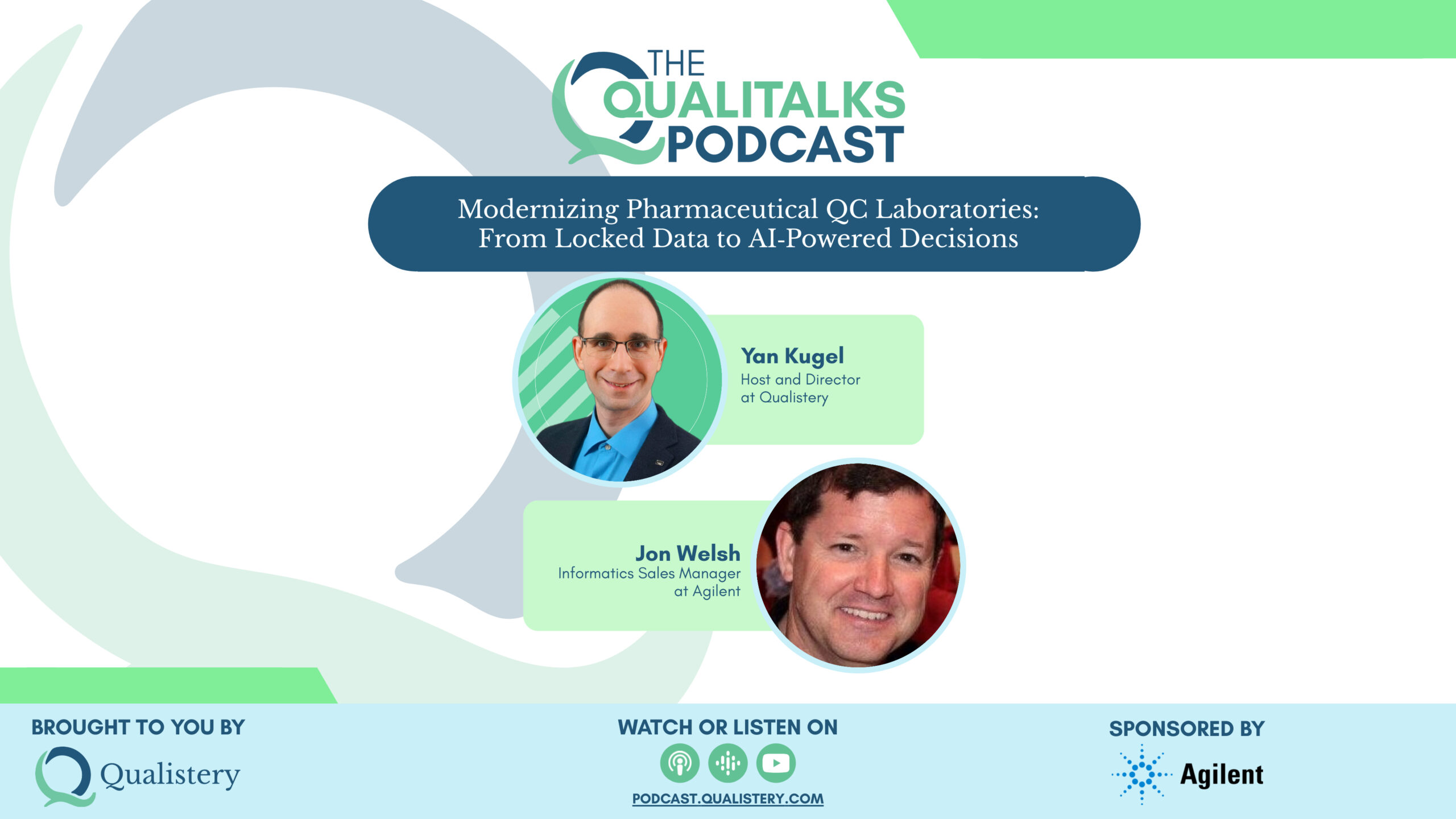
Table of Contents
For many years, pharmaceutical laboratories focused on one main goal: keeping data secure, controlled, and ready for inspection.
That goal has not changed. Data integrity, audit trails, access control, and version history remain key parts of GMP work. Yet the role of laboratory data is changing. Data is no longer seen only as an inspection record. It is also becoming a source of insight that can help laboratories spot risks, reduce downtime, plan resources, and improve daily work.
This article summarizes key insights from the discussion between Yan Kugel and Jon Welsh from Agilent as they dive into modern data standards, AI‑driven insights, and the future of GMP labs.
Jon is an expert on laboratory informatics and software that help pharma and regulated labs connect data, standardize methods, and support compliant workflows.
This episode is supported by Agilent. They support scientists around the world in the life sciences, diagnostics, and applied chemical and materials markets. Our software portfolio is an integrated suite of products that includes sample management, data acquisition and analysis, data management, lab workflow management and lab operations management – improving lab throughput and the quality of your results. Together with our customers, we’re bringing great science to life.

Since the introduction of 21 CFR Part 11 in 1997, many laboratories have focused on protecting electronic records. They built systems with controlled access, audit trails, version control, and secure storage.
This approach helped laboratories meet regulatory needs. Data was placed in controlled systems where only approved users could make changes. The result was a strong focus on protecting records from unauthorized changes.
Now, companies are looking at the same data in a new way. Data stored over 15, 20, or even 30 years may contain useful patterns. It can show how instruments perform, how often errors occur, when maintenance is needed, and where laboratory processes slow down.
AI-supported tools can review large data sets much faster than a person can. They can help teams ask questions that were difficult to answer in the past.
For example, a laboratory may want to know which instruments have the highest downtime. It may want to find runs that stopped early or results that needed repeated integration. It may also want to understand why one instrument operates near full capacity while another is rarely used.
The data has always existed. The difference is that laboratories now have better tools to examine it.
Regulatory inspections have often involved reviews of audit trails and electronic records. Yet a person cannot easily review thousands of lines of audit trail data and find every unusual event.
Data analysis tools can help narrow the focus. They can identify records that may need further review. A regulator or quality team could ask to see runs that stopped before the planned end time. They could review results that were integrated or reintegrated several times. They could also look for repeated changes, unusual trends, or events outside normal laboratory behavior.
This does not mean that software replaces an investigation. It means that the software can help people find where to look.
The quality team still needs to understand the event, review the source records, speak with the people involved, and decide whether the event affected the result or product quality. Data tools support that work. They do not remove the need for scientific judgment.
One practical use for historical data is predictive maintenance.
Most laboratories already record maintenance activities. They know when lamps, seals, filters, columns, or other parts were changed. They also know when instruments went out of service.
When this information is combined, a laboratory may find useful patterns. A lamp may fail after about 18 months of normal use. A filter may need replacement after a certain number of runs. A pump seal may show a higher failure rate after a specific period.
The laboratory can then plan maintenance before a failure takes place. It may choose to replace a part at 15 months instead of waiting for it to fail during a critical run.
This can reduce unplanned downtime. It can also help laboratories plan staff time, spare parts, and service visits.
Predictive maintenance does not remove the need for standard preventive maintenance procedures. It adds another source of information. The laboratory still needs approved procedures, defined responsibilities, suitable records, and a clear process for reviewing the results.
AI tools work best when data is easy to read and understand. A result without context may have limited value. A useful data set should show what each field means and how the information relates to other records.
This is where data standards become important.
Different instruments and software systems may use different names for the same type of information. One system may call a field “sample ID.” Another may call it “sample number.” A third may use a different term.
These differences make it harder to combine data from several systems. A company may need a team of data scientists to map each field and create links between systems.
Let’s take example of the work of the Allotrope Foundation, which developed standards for scientific data. One of these is the Allotrope Data Format. The foundation later developed the Allotrope Simplified Model, often called ASM.
The simplified model uses a descriptive structure based on JSON. This makes the data easier for software tools to read and process. The goal is to create a common way to describe laboratory data across systems and vendors.
A standard only works when companies follow the same standard. If every vendor creates its own version, users may face the same data exchange problems again.
Pharmaceutical companies often need to keep records for many years. Some data may need to remain available for several decades, based on company procedures, legal duties, or regulatory expectations.
Long-term access creates a basic question: will the data still be readable in the future?
A proprietary file format may become difficult to access if a vendor stops supporting it. A clear, documented, and widely supported structure can reduce this risk.
A standard format can also help when companies work with contract laboratories or manufacturing partners. If each organization stores data in a different way, sharing and reviewing records becomes harder.
A shared data structure can make it easier to transfer information between sites, companies, and systems. This is useful for both routine work and investigations.
Still, companies should examine what a vendor means when it says it can “standardize” data. Data placed in a JSON file is not automatically an Allotrope Simplified Model file. The file must follow the agreed structure and definitions.
Converting data into a standard format is not always a one-click task.
The starting point matters. A company with a central scientific data management system, clear records, and controlled access may have a shorter path. A company with data spread across paper files, local spreadsheets, old databases, and different systems may face more work.
Historical data may also have gaps. Some records may lack clear descriptions. Some systems may not have stored all the metadata needed for future analysis.
A sensible plan should begin with a review of the current state. The company should understand where its data sits, who owns it, what format it uses, and how well the records are described.
The next step is to define the questions the laboratory wants to answer. These questions can help guide the data work. A laboratory may want to start with instrument use, maintenance, compliance events, or sample turnaround time.
Starting with a clear business or quality question can prevent the project from becoming an unfocused search through every available record.
AI analysis should not change the status of the original GMP record.
There is a model where the raw data remains in a controlled and compliant system. A separate, read-only representation can then support analysis and reporting.
This separation can help protect the source record. The analytical copy may be converted into a format that AI tools can read. Yet the original record remains under access control, version control, and audit trail protection.
Each company must assess its own systems and regulatory duties. It must also decide how the converted data relates to the official record. That assessment may require input from quality assurance, validation, laboratory operations, IT, and data governance teams.
The key point is simple. A data analysis tool should not weaken control over the source record.
Large data sets can create a new problem. A laboratory may have more questions than it can reasonably investigate.
The answer is not to analyze everything at once. Teams should start with questions that link to quality, risk, cost, or laboratory performance.
A laboratory may ask which instruments are used most often. It may look at capacity and downtime before requesting new equipment. It may compare the number of samples run on each instrument. It may also review whether several departments have separate instruments that are each used only a small part of the time.
This type of analysis can support better resource decisions. It may show that a laboratory needs a new instrument. It may also show that the company has unused capacity at another site.
The same approach can support quality oversight. A quality dashboard could show events outside standard procedures, repeated data changes, or unusual process patterns. The team can set agreed limits and ask the system to flag records that need review.
The tool does not decide what the event means. It helps the right people see the event sooner.
Attention all pharma professionals!
Stay ahead of the game and be fully compliant with regulations.
Join Qualistery’s expert-led educational webinars and stay up-to-date with the latest trends and regulations.
With top industry providers as our partners, we bring you the best speakers and informative sessions.
Visit our website to browse our upcoming webinars and take the first step toward furthering your knowledge and success in the industry.
Don’t miss out on this opportunity to invest in your professional growth.

Data analysis may become a new role within larger laboratory organizations.
A data scientist may understand the data structure, build dashboards, and connect information from different systems. That person may not know what a laboratory manager needs to see each morning.
A laboratory manager may need a view of sample workload, instrument capacity, and turnaround time. A quality leader may need a view of compliance risks and unusual events. A site head may need information about staffing, cost, and investment needs.
Each user must define the questions and limits for the dashboard. The data scientist can then build the view around those needs.
This work requires cooperation between technical and laboratory teams. A useful dashboard is not created by data skills alone. It must reflect real laboratory processes and approved quality expectations.
AI can identify patterns and produce suggestions. It can also make mistakes.
Large language models may produce information that sounds correct but is not supported by the source data. They may interpret a question in an unexpected way. They may also give an answer that reflects the wording of the question rather than the facts in the records.
For GMP laboratories, this creates a clear need for human review.
The person using the tool must check the source data, understand the question, and review the result. The company should test the tool with known examples. It should compare AI-supported results with manual calculations or established reports.
This work should form part of the company’s risk assessment and validation approach. The company should define what the tool may do, what it may not do, and when a human must approve the result.
AI can help present information. A qualified person must still make the scientific and quality decision.
Laboratories are also moving toward greater physical automation.
A connected system may prepare samples, move vials, start instruments, collect data, and send results to another system. Robotic arms can handle repeated steps. Software can coordinate activities across instruments and systems.
This type of setup is sometimes called a “lights-out” laboratory. It can operate with little or no human activity during certain stages.
Automation can improve traceability. A system can record the volume of solutions used, the time of each step, and the identity of each sample. It may also support better inventory control because the system knows how much material it has taken from a container.
Yet automation must be designed carefully. The company still needs clear procedures, system controls, maintenance, alarms, data review, and a plan for handling failures.
Automation works best when the systems involved can exchange data. This is another reason why common data standards matter.
The use of robots and AI often raises concern about jobs. Some repetitive tasks may require fewer people in the future. Yet laboratories will still need people to handle complex work, unusual events, method changes, investigations, and scientific decisions.
Automation may allow laboratory staff to spend less time on repetitive movement, transcription, and manual checks. They may spend more time reviewing results, solving problems, improving processes, and managing exceptions.
New skills will also become more useful. These may include data review, dashboard design, system oversight, automation support, and the ability to assess AI-generated information.
The exact effect will vary by laboratory. Companies should plan for training and role changes instead of assuming that technology will simply remove work.
AI and cloud services can offer useful capabilities, but they also create costs.
A company may pay for data storage, data transfer, computing power, software licenses, and AI usage. Large data sets and repeated AI queries can increase the bill quickly.
Cloud adoption offers a useful lesson. Many companies once moved from local servers to cloud systems and later found that cloud costs were higher than expected. The same pattern may happen with AI.
Companies should set clear goals and measure the value of each use case. They should monitor usage and cost. They should also decide when a simple report or rule-based system can answer a question without using a complex AI model.
The best solution is not always the most advanced one. A clear question, good data, and a suitable tool may provide more value than a large system with unclear goals.
Laboratories that are still deciding where to start can take a careful first step.
Begin by reviewing the data already available. Identify the systems that hold raw data, metadata, audit trails, maintenance records, and instrument activity.
Next, choose one use case. Predictive maintenance, instrument utilization, or review of unusual data events may provide a clear starting point.
Define the source of truth. Decide which record remains official and how any analysis copy will be controlled.
Then, assess the data structure. Check whether the required fields have clear definitions and whether the data can be shared across systems.
Finally, involve the right people. Laboratory operations, quality assurance, IT, validation, data science, and management should agree on the purpose and controls.
A small, well-defined project can teach the organization more than a large project with no clear result.
GMP laboratories have spent decades protecting data. The next step is to make careful use of that data without weakening its control.
AI can help laboratories find patterns, identify risks, plan maintenance, and use equipment more wisely. Standardized data can make these tasks easier across systems and sites. Automation can reduce repetitive work and improve record collection.
The human role remains central. People must define the questions, assess the risks, review the results, and make the final decisions.
Companies should also make sure they own and control their data. They should ask whether a solution uses a true industry standard or a vendor-specific version. They should check how historical data can be accessed and how the system will support future changes.
The move toward digital and AI-supported laboratories is already underway. Laboratories that start with clear goals, controlled data, and practical use cases will be better prepared for what comes next.
What is your laboratory doing with its historical data? Are you using it only for inspections, or are you also using it to improve quality and daily operations?

Jon Welsh is the Americas Informatics Sales Manager at Agilent Technologies, based in Wilmington, Delaware. He focuses on laboratory informatics and software that help pharma and regulated labs connect data, standardize methods, and support compliant workflows. His recent activity highlights strong interest in OpenLab, USP MethodConnect, digital method execution, multi-attribute methods for biopharma QC, and practical use of AI in laboratory operations. He is especially focused on open standards, data access, and better system interoperability across the laboratory.
Learn how continuous analytics, compliance, sustainability, and AI are reshaping water management in pharma manufacturing.


Post comments
This post currently has no comments.