
 Apple Podcasts
 Spotify
 YouTube
Preventing Alarm Fatigue in Life Science Facilities with EMS and Smart AI [Stephen Tierney]
Learn how continuous analytics, compliance, sustainability, and AI are reshaping water management in pharma manufacturing.
 play_arrow
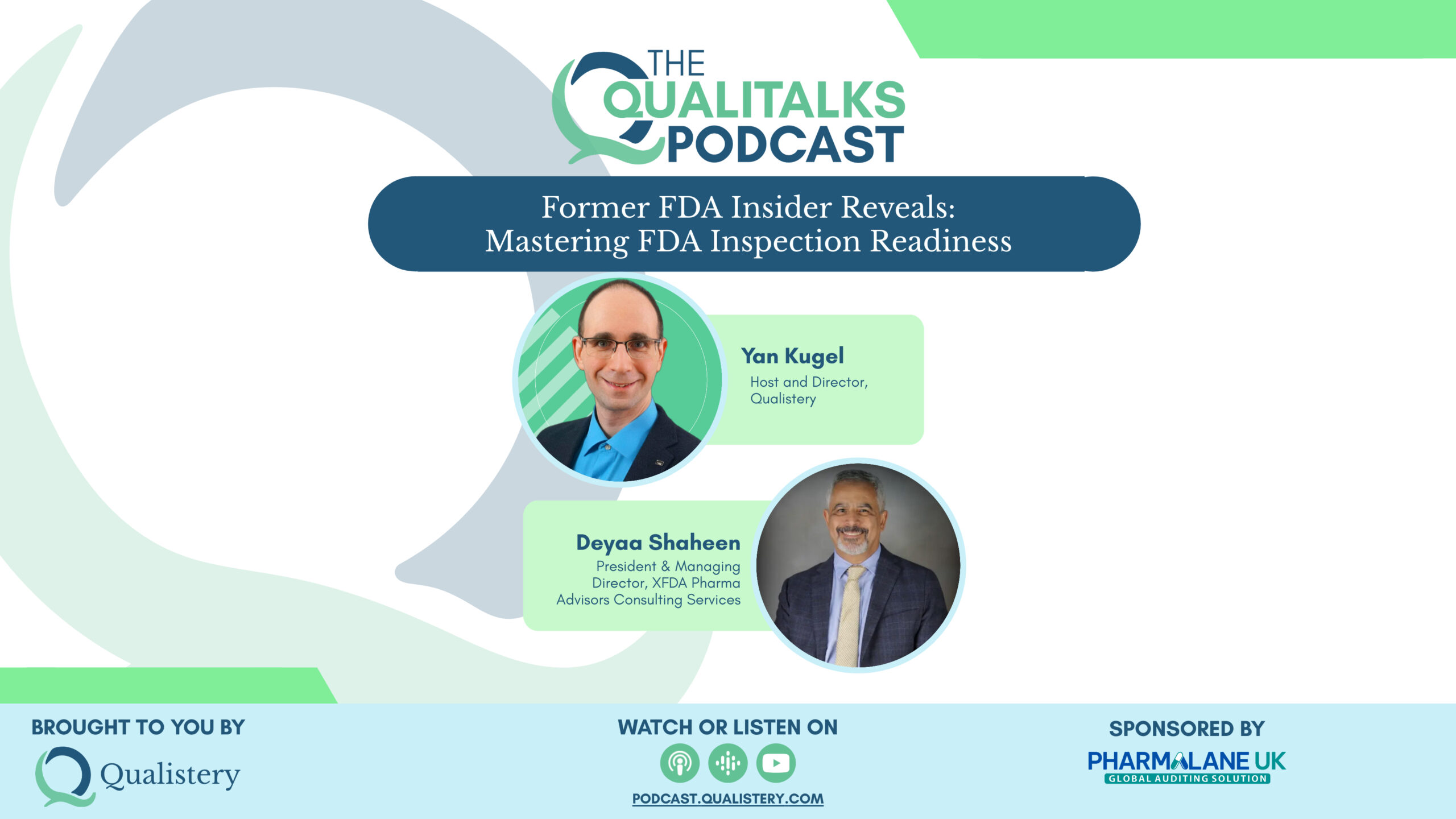
Former FDA Insider Reveals: Mastering FDA Inspection Readiness [Deyaa Shaheen] Deyaa Shaheen
 play_arrow
Preventing Alarm Fatigue in Life Science Facilities with EMS and Smart AI [Stephen Tierney] Stephen Tierney
 play_arrow
Modernizing Pharmaceutical QC Laboratories: From Locked Data to AI‑Powered Decisions [Jon Welsh] Jon Welsh
 play_arrow
Reducing Risk and Costs: Continuous Water Quality Monitoring in Pharmaceutical Production [Konrad Sägesser] Konrad Sägesser
play_arrow
Former FDA Insider Reveals: Mastering FDA Inspection Readiness [Deyaa Shaheen] Deyaa Shaheen
Table of Contents
A company can have strong procedures, trained employees, and a history of successful inspections. It can still receive serious findings during its next FDA visit.
Why does this happen? FDA inspections do not all have the same purpose. Investigators may focus on different systems, ask different questions, and follow different paths through a facility. A site that prepares for one inspection type may be poorly prepared for another.
This article summarizes the key insights from the discussion between Yan Kugel and Deyaa Shaheen, President & Managing Director, XFDA Pharma Advisors Consulting Services where he shares hard‑won insights on inspection types, common pitfalls, and how to build a culture of continuous compliance.
Deyaa has led and supported more than 50 FDA pre-approval and surveillance inspections and conducted over 250 mock regulatory audits across pharmaceutical manufacturers, CMOs/CDMOs, and contract laboratories worldwide.
This episode is sponsored by PHARMALANE UK , a well-established, UK-based GxP auditing consultancy providing a broad range of quality auditing services to 800+ pharmaceutical companies worldwide as their client.
Learn More About PHARMALANE UK

Many companies treat inspection readiness as a scheduled activity. They start preparing after submitting an application or after receiving notice of an upcoming inspection.
This approach creates a serious problem. By the time preparation begins, major weaknesses may be difficult to fix. Problems may exist in the quality system, data records, training, manufacturing processes, or company culture.
Inspection readiness should be part of everyday operations. Companies should ask themselves each day whether employees are following procedures, deviations are being investigated on time, corrective actions are effective, and records can be retrieved quickly.
Employees should also understand the work they perform. Data and records must be complete, accurate, and traceable. Departments should report problems openly instead of hiding them until an inspection begins.
A clean-up exercise before an inspection cannot repair years of weak practices. It may also create a false sense of security. A site may look prepared on paper while its daily operations tell a different story.
One of the most common mistakes is treating every FDA inspection in the same way. The inspection type sets the direction of the visit. It also affects the documents, subject matter experts, and systems that the company should prepare.
A pre-approval inspection, or PAI, takes place after a company submits an application to the FDA. The agency uses the inspection to assess whether the site and its data support approval.
During a PAI, the FDA may review whether the site’s operations match the information submitted in the application. Investigators may examine the integrity of the data supporting the application and assess whether the company is ready to manufacture the product at the proposed site.
The inspection may also cover quality oversight of development work, validation activities, analytical testing, exhibit batches, and proposed batch records.
A company preparing for a PAI should identify the people who can explain the product and its supporting data. This may include the scientists who developed the product, analysts who performed testing, personnel involved in validation, and employees who prepared the batch records.
A routine surveillance inspection has a broader purpose. It may cover the full site and review the FDA’s major quality systems.
The inspection may include production and process controls, laboratory controls, facilities, equipment, materials management, packaging, labeling, data integrity, deviations, and CAPA.
A PAI does not prepare a company for every issue that may arise during a surveillance inspection. The focus, records, and subject matter experts may be different.
Companies should review the full quality system instead of preparing only for topics that drew attention during the last inspection.
A for-cause inspection happens when the FDA has a specific concern. The trigger could include an adverse event, product recall, complaint trend, data integrity concern, or another regulatory signal.
The company should understand why the FDA is visiting before deciding how to respond. The investigation may focus deeply on one issue. It may also expand if investigators identify related problems.
A site that uses the same inspection plan for every visit may miss the areas that matter most.
A common belief in the industry is that a successful inspection means the site is ready for the next one.
That assumption is risky. A site may receive several “No Action Indicated” outcomes over a number of years and then receive an “Official Action Indicated” outcome during a later visit.
This does not always mean earlier investigators missed something. Inspectors have different backgrounds and may focus on different parts of the operation.
An investigator with a microbiology background may spend more time reviewing environmental monitoring and laboratory practices. An investigator with an engineering background may focus on equipment, facilities, utilities, and maintenance. An investigator with a chemistry background may examine laboratory controls, methods, and analytical data.
The site must be ready for all of these areas.
A past inspection can also create a false sense of comfort. Employees may say that the last investigator did not ask about a topic or that the site has never received a finding in a particular area.
That thinking can leave important weaknesses unaddressed. Companies should review the full quality system and identify problems in every area, even if previous inspectors did not examine them closely.
Large companies often have deep technical knowledge and large quality departments. Yet size does not protect a company from inspection findings.
People who work in the same facility every day may stop seeing problems. A damaged wall, corrosion on equipment, poor documentation, or a gap in cleaning practices can become part of the background.
An outside reviewer may notice the issue right away.
This is similar to seeing a hole in a wall every day. Over time, employees stop noticing it. A person visiting the site for the first time may see it immediately.
Independent reviews can help reduce this routine blindness. An external reviewer can ask questions that employees no longer think to ask. The reviewer can also follow a process from beginning to end and identify gaps between written procedures and actual practice.
Quality assurance often leads inspection preparation, but inspection readiness does not belong to QA alone.
It involves every group that creates, reviews, stores, or uses regulated records. This includes quality assurance, quality control, manufacturing, engineering, maintenance, metrology, validation, regulatory affairs, information technology, warehousing, and supply chain.
Consider a delayed deviation. Manufacturing may know why work was delayed. QA may need to review the justification and impact. Engineering may need to provide technical information. Validation may need to assess whether the delay affected a validated state.
If these groups do not communicate, the company may struggle to explain the issue during an inspection.
Create an inspection readiness team with representatives from major departments. The group should review open issues, identify problems that cross department lines, and assign clear actions.
Shared ownership matters. If a company fails an inspection, the failure belongs to the company. If the company succeeds, every department helped make that success possible.
Employees may hide problems because they fear blame, discipline, or job loss. That fear can prevent management from learning about an issue until it becomes much larger.
A healthy quality culture gives employees a safe way to report concerns. Senior leadership must set this expectation and reinforce it through daily actions.
Employees should understand that reporting a problem is better than hiding it. A deviation is not automatically a personal failure. Management should focus on facts and root causes, and retaliation for raising a concern should not be accepted.
Problems should be addressed early, while they are still manageable.
This can be harder in some countries or company cultures than others. Local culture can affect how freely employees speak with managers. Leadership still has a central role. A safe reporting culture must apply across locations and departments.
When an employee gives an inaccurate answer to protect a manager or avoid blame, the damage can spread quickly. Once an investigator catches a lie, trust disappears. The investigator may then verify every answer, record, and explanation in much greater detail.
Honesty protects the company. It also allows the inspection to focus on solving real problems.
Attention all pharma professionals!
Stay ahead of the game and be fully compliant with regulations.
Join Qualistery’s expert-led educational webinars and stay up-to-date with the latest trends and regulations.
With top industry providers as our partners, we bring you the best speakers and informative sessions.
Visit our website to browse our upcoming webinars and take the first step toward furthering your knowledge and success in the industry.
Don’t miss out on this opportunity to invest in your professional growth.

A strong response during an inspection starts with knowledge and preparation. Employees should understand their processes, procedures, records, and responsibilities.
Listen carefully to the question and answer only what was asked. Give factual answers and support them with records when needed. Bring in the correct subject matter expert when a question involves another department.
Do not guess. If the question is unclear, ask the investigator to repeat or explain it. This is better than bringing the wrong document or giving an answer about a process the employee does not own.
The company should also bring the right experts into technical discussions. A question about cleaning validation may require input from microbiology, manufacturing, facilities, maintenance, and the laboratory. One person may not have enough knowledge to explain the entire process.
Document retrieval is one of the clearest signs of inspection readiness.
Common problems include long delays, incomplete files, missing pages, obsolete procedures, inconsistent versions, and poor tracking of records entering or leaving the inspection room.
Companies should also avoid providing large amounts of irrelevant information. Investigators need the records that answer their requests. Extra documents can create confusion and lead the inspection in an unexpected direction.
A company should know what it has provided, what remains outstanding, who owns each request, and when each item will be delivered.
Documents such as standard operating procedures, validation records, and equipment qualification records should be easy to retrieve. A request for a routine record should not take several hours.
Some delays may be intentional. An investigator can interpret repeated delays as refusal or obstruction. When an investigator sits for hours waiting for a document, the situation can become a serious concern.
If a record will take time to prepare or retrieve, communicate this clearly. Explain the reason for the delay and provide a realistic delivery time.
A delay is easier to manage when it is honest and supported by a clear plan. Repeated delays without explanation can damage the company’s credibility.
A mock inspection can show whether a site is ready. Its value depends on how it is conducted.
A basic document review may confirm that procedures exist. It may not show whether employees follow them, whether records are reliable, or whether the company can answer questions under pressure.
A useful mock inspection should review manufacturing, laboratory controls, quality systems, data integrity, documentation practices, training, deviations, CAPA, and the document request process.
It should also test communication between departments and the company’s response to difficult questions.
An independent reviewer with direct FDA inspection experience can provide a useful outside view. The reviewer should apply methods that resemble those used by FDA investigators. This may include tracing records backward and forward, comparing procedures with actual practices, reviewing electronic data, interviewing employees, and checking whether CAPA actions solved the root problem.
A mock inspection is only the first step. Finding weaknesses does not make the site ready. The company must fix the problems, examine whether they are isolated or systemic, and confirm that the corrective actions worked.
Quality leaders can begin with an independent, risk-based review of the site.
Start with areas that often reveal system weakness, including deviations, out-of-specification results, CAPA, data integrity, quality oversight, training, document control, supplier oversight, equipment, and facility maintenance.
Ask whether each system works in practice. Do not stop at the question, “Do we have an SOP?”
A stronger review asks whether the procedure is clear, employees follow it, deviations are justified, records are complete and contemporaneous, management reviews trends, corrective actions address root causes, and the company can prove that each fix worked.
Inspection readiness grows from these daily habits.
FDA inspection preparation should be specific to the inspection type, but readiness should exist every day.
Pre-approval, surveillance, and for-cause inspections have different goals. They require different records, experts, and preparation plans. A successful past inspection does not guarantee a successful future inspection. A large quality department does not replace open communication and careful review.
The strongest sites identify weaknesses before the FDA does. They encourage employees to report problems early. They involve all departments in inspection readiness. They retrieve complete and accurate records quickly. They answer investigators honestly and clearly. They use independent mock inspections to test real behavior and verify that corrective actions worked.

Accomplished Quality and Compliance Executive with nearly 30 years of global experience across pharmaceutical, biopharmaceutical, sterile, biologics, and regulatory environments. Former U.S. FDA Drug Investigator (OII/ORA) and CDER Compliance Officer with extensive expertise in CGMP compliance, inspection readiness, data integrity, and global regulatory affairs. Led and supported more than 50 FDA pre-approval and surveillance inspections and conducted over 250 mock regulatory audits across pharmaceutical manufacturers, CMOs/CDMOs, and contract laboratories worldwide. Recognized as a subject matter expert in FDA 483 and Warning Letter remediation, Quality Management System (QMS) transformation, CAPA, risk management, and sustainable compliance strategies. Experienced in CMC and data integrity reviews supporting NDA, ANDA, and BLA submissions.
Learn how continuous analytics, compliance, sustainability, and AI are reshaping water management in pharma manufacturing.

Post comments
This post currently has no comments.